All women and children, regardless of their immigration status, should have access to safety, support, and pathways to independence when leaving domestic and family violence.
In NSW, roughly 31% of the population – close to one in three people – are born overseas in a majority non-English speaking country (ABS, 2021). While data on temporary visa holders is limited, estimates indicate that there are nearly 500,000 temporary visa holders (excluding New Zealand citizens) living in NSW (with 85% of these in Sydney), representing 6% of the population (ABS, 2023b).
In Australia, over 25% of people killed in the context of domestic violence between 2000 – 2022 were born outside the country, with 12.8% holding temporary visas at the time of their death (DVDRT, 2024).
Women on temporary visas face unique challenges – limited rights, little to no income and significant barriers to support – making immigration status a critical factor impacting the safety and survival of women and children experiencing domestic and family violence.
To further understand the challenges and barriers faced by women on temporary visas experiencing domestic and family violence, DVNSW held a Roundtable and disseminated a survey to member services and frontline workers in late 2024. The aim was to identify gaps in the current support system and explore potential solutions to better address their needs.
Key issues identified in the roundtable include inconsistencies in data reporting, ineligibility for federal and state support, financial burden placed on services, complexity of casework, limited exit pathways, and the need to prioritise clients based on immigration status.
Survey results found most women on temporary visas and their accompanying children are staying in refuges mostly located in metropolitan Sydney for extended periods, sometimes up to four years. Exit pathways are scarce and women on temporary visas and their children are largely reliant on transitional housing.
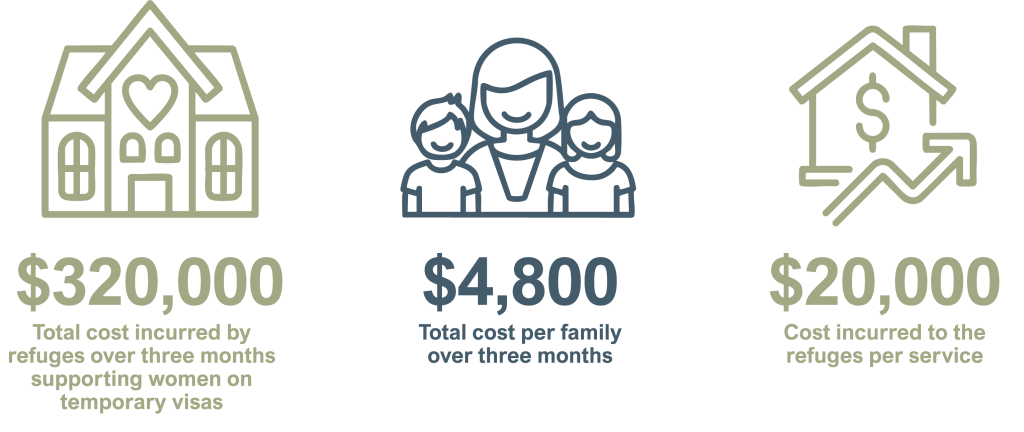
The financial impact on services is concerning, with the average cost per family close to $5,000 for a three-month period. Funding to provide this support is typically secured through donations, brokerage and other philanthropic sources.
Recommendations made to address the urgent support needs for women on temporary visas include:
- Financial support for refuges to meet the complexity of need
- Increasing the domestic and family violence specialist workforce in refuges, migrant and refugee services, translator and interpreter services, and migration-related legal support
- Housing and homelessness system reform
Improved data collection and reporting - Investment in prevention and community awareness programs