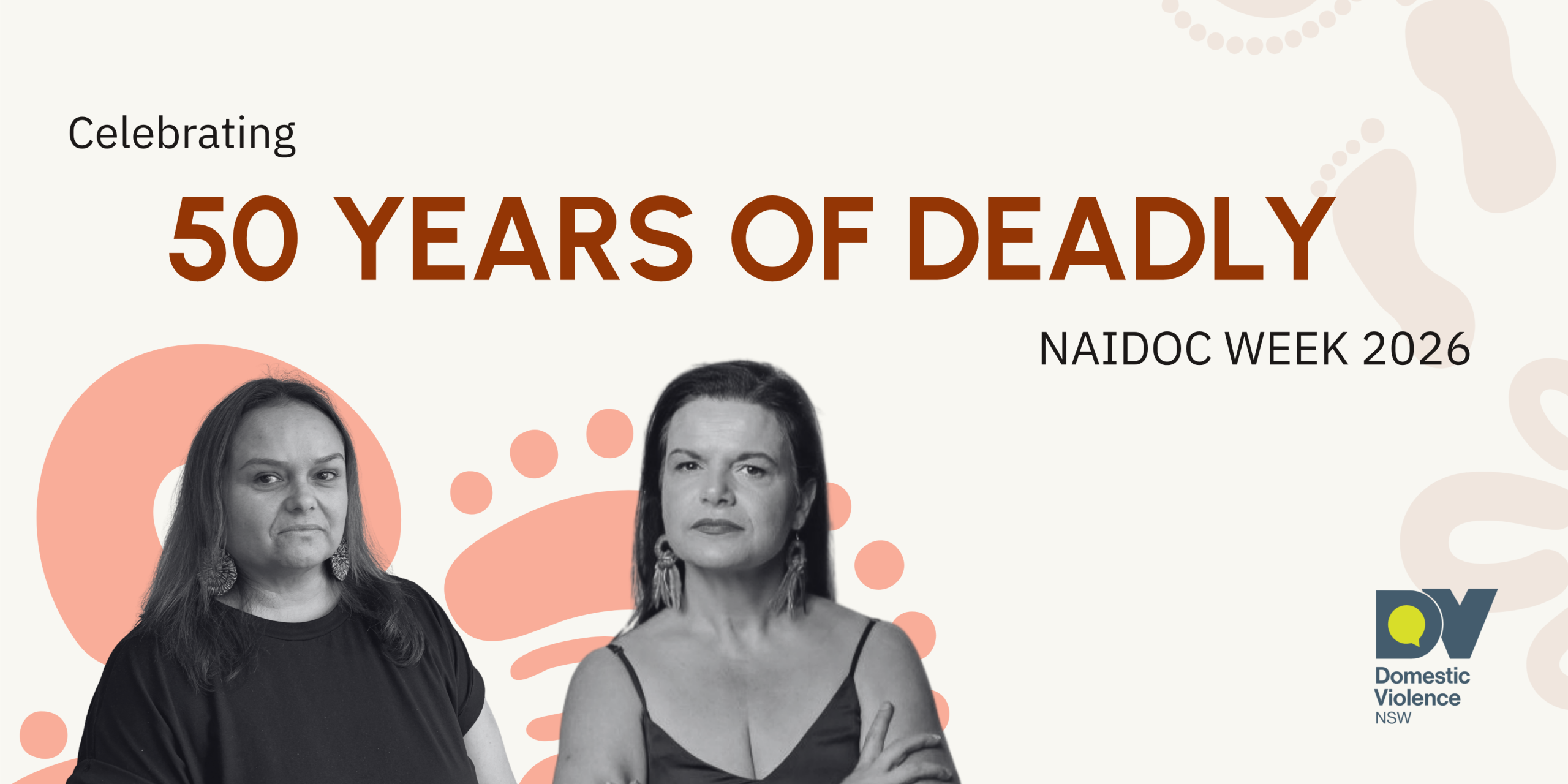
In conversation With Stacey Buan-Toomey, Aboriginal Policy Officer, DVNSW, and Cecilia Mckenzie, Aboriginal Policy, Engagement and Advocacy Manager, DVNSW
This year’s NAIDOC Week celebrates 50 Years of Deadly – marking five decades of honouring the history, culture and achievements of Aboriginal and Torres Strait Islander peoples.
A proud Wiradjuri woman, mother and grandmother, Stacey Buan-Toomey recently joined Domestic Violence NSW in the role of Aboriginal Policy Officer. In this conversation, Cecilia McKenzie, another proud Wiradjuri woman and DVNSW Aboriginal Policy, Engagement and Advocacy Manager, sits down with Stacey to talk about what NAIDOC Week means to her, the strength of Aboriginal culture, and why celebrating Aboriginal ways of knowing, being and doing is essential to creating domestic and family violence responses that are culturally safe, effective and grounded in healing.
Stacey also reflects on what brought her to Domestic Violence NSW and the passion that continues to drive her advocacy for Aboriginal women and children.
Cecilia Mckenzie: Firstly, congratulations and welcome to DVNSW in the role of Aboriginal Policy Officer. Can you tell us a little about yourself and what drew you to this role?
Stacey Buan-Toomey: Thanks so much. I’m excited to be part of the team.
I am a proud Wiradjuri woman from Central West NSW. I was born and raised on Wiradjuri Country and am still connected to my Country. My mob are the Toomey, Swan and Peckham families. I’m a mother and grandmother living on beautiful Dharug Country.
What brings me to Domestic Violence NSW is that domestic and family violence is very personal to me. It has always been my passion to support and advocate for Aboriginal and Torres Strait Islander women and children. I feel so grateful that I get to advocate for change and work towards safer outcomes for Aboriginal women and children experiencing domestic and family violence.
What does NAIDOC Week mean to you personally?
I love NAIDOC Week. Being in community is a feeling of pride and a time to reflect on the strengths and resilience of our communities. Seeing everyone’s smiling faces reminds me of the importance of culture and identity and of acknowledging our Elders who have paved the way for us all. It fills my cup and keeps me going.
This year’s NAIDOC theme, 50 Years of Deadly, invites us to reflect on where we’ve come from and where we’re heading. What does this year’s theme evoke for you as an Aboriginal woman and as someone working in domestic and family violence policy and advocacy?
This year’s theme, 50 Years of Deadly, evokes a feeling of gratitude. I think about the generations of staunch Aboriginal and Torres Strait Islander people who have fought for justice and self-determination and didn’t give up.
As an Aboriginal woman working in this space, I feel a lot of responsibility to advocate harder for more awareness of the impact that domestic and family violence has on people and communities. I feel hope with the National Plan to End Violence against Women and Children – Our ways, Strong Ways, Our Voices. It’s a plan that demands system change for our Aboriginal and Torres Strait Islander women and children, and highlights that the solutions sit with out people and communities.
There is often so much focus on the challenges facing Aboriginal communities. What strengths do you think the broader sector can learn from Aboriginal ways of knowing, being and doing?
There are so many strengths within our communities.
Aboriginal and Torres Strait Islander ways of knowing and being are embedded in our relationships, our respect for people and Country, and our connections to community. The rest of the sector can learn from partnerships, listening to lived experience, and allowing for community-led solutions.
I like to say, “If it’s done our way, it’s the right way.”
From your perspective, what does culturally safe practice look like when supporting Aboriginal victim-survivors?
Leading with culture at the forefront.
It’s about creating a safe environment where people feel respected and listened to. It needs workforces that are educated on the impacts of colonisation, listening without judgement, building strong and safe relationships, showing up from a place of humility, holding space for truth-telling, and advocating that Aboriginal women and children are getting the best service delivery they deserve.
If you could share one message with the domestic and family violence workforce during NAIDOC Week, what would it be?
Keep holding space for learning, keep listening, continue to walk beside our women and children. Keep showing up. Stay strong, stay deadly.
Finally, what gives you hope?
The next generation, our inspirational Elders who continue to give so much to our communities and never ask for anything back, and my children and who they are in this world. That’s what keeps me hopeful.
Happy NAIDOC everyone!